Showing posts with label Bad Things. Show all posts

Monday, March 1, 2010

Brain drain

So, I get an email this morning from someone claiming that they represent the Israeli ministry of science and are looking to generate a list of Israeli "brains" that are currently living abroad. Great. First thought - it's probably phishing.
Second thought - other people got it as well, so may be it's not.
Third thought - I clicked the link, a genuinely looking site comes up. Great.

I clicked the "המשך" (next) button that will allow me to view/update my details, and - surprise! It doesn't work.

What's the f***?
Didn't they hear of checking their website? How do they expect Israeli scientists to return to such a "partachi" state?

Wednesday, September 23, 2009

Good Things, Bad Things: Measurements and Distances

This post is the last and belated part of the Good Things, Bad Things series.

The USA is the only industrialized country to be using a systems of units that differs from the international standardized, or metric, system. In fact, the World Factbook by the CIA, in Appendix G, states that:
At this time, only three countries - Burma, Liberia, and the US - have not adopted the International System of Units (SI, or metric system) as their official system of weights and measures. Although use of the metric system has been sanctioned by law in the US since 1866, it has been slow in displacing the American adaptation of the British Imperial System known as the US Customary System. The US is the only industrialized nation that does not mainly use the metric system in its commercial and standards activities, but there is increasing acceptance in science, medicine, government, and many sectors of industry
This issue about units of measurements causes many differences, both for the good and for the worse. The system now called American Customary Units was derived from the English and later Imperial Units, but even that is not entirely correct or accurate. For example, an American Wet Pint is much smaller than its British counterpart (and even the Amreican dry Pint for that matter, but who the hell drinks a dry beer?!), and the only explanation for that might be that no one wants to drink more than an American pint of domestic beer, especially when compared to a nice smooth pint of Guiness. Anyway, I digress.

One problem with American Customary Units is that they hold true only at a certain location on Earth, specifically at latitude 45, which is roughly where the USA is. This is so typical of Americans: to invent a set of units that can be true only at a certain location in the universe. As usual, as long as Americans keep to themselves and don't try to meddle with the affairs of others that is not a problem. However, they rarely do, and at some point they even decided to venture to space. Now, on space, as everyone knows, there is no gravity. As a result, there is also no definition of weight, which is the force that stems from the product of mass and gravity, hence no gravity - no weight. Since the American Customary Units assume a weight of 1 lb as its basic unit of measurement, and calculates the mass that produces this weight at latitude 45 and sea-level, this entire system of units is useless in space. Thus, for scientific purposes, it makes more sense to use Standard International units, i.e. the metric system, whose base unit is the Kg for mass, and not weight. Mass is invariant no matter what the gravity acceleration is. Why am I telling you all this? For two reasons: 1) it's virtually impossible to teach American students to distinguish between mass, weight and the units used for both. They know that some multiplication or division is required, but not exactly which is what. 2) it's the cause of one of the most colossal failures in NASA's history.

There are also positive sides to using American units. For example, we still think about temperature in Celsius, but if you look at Fahrenheit it makes more sense: the weather in Cincinnati this year ranged from really cold when it was zero Fahrenheit to hot when it was 100 Fahrenheit. On the other hand, spatial distances are shrunk or expanded as needed: for example it's much nicer to live in a 1000 sq. ft. apartment than in a 100 sq. meters apartment. It's easier to drive 500 miles to a party than it is to drive 800 Kms, as we did on the weekend of the 4th of July. ;-)

Friday, September 18, 2009

Cincinnati Bell's service

We have our internet connection with Cincinnati Bell. At first it was great: high speed fiber optics. However, we had to disconnect the fiber optics because of our move to another apartment (where we will have a new non-fiber optics internet with Cincinnati Bell). Therefore, we scheduled a time for a technician to come pick up the old equipment. It was between 8 and 12 today. Naturally, no one showed up. It's a working day, and they just didn't give a damn about people being left at home and missing work.

So, I called their office. It took a Cincinnati Bell representative 18 minutes just to answer the phone! This is such a bad service I am now considering disconnecting from them altogether.

A technician finally called. According to him no one told him it was supposed to be in the morning. He said that it happened a lot with the office mixing orders.

This company is a disgrace to American service standards.

Friday, August 28, 2009

Good Things, Bad Things: Privacy

This post is part of the "Good Things, Bad Things" series.

In general, the right for privacy in our world is diminishing. Some proof for that are: the ever growing number of CCTV cameras in city centers (especially in the UK, where this thing has almost gotten to the point of being a public Big Brother), Google's Street View and its privacy infractions, online mail applications that use key words to put contextual ads, and electronic data everyone leaves behind him just to prove he or she is still alive, e.g. on Facebook, Twitter, cellular networks, blogs, etc. To this one can add the debate over biometric database, especially the one lobbied for and promoted by MK Sheetrit in Israel.

Photo: Hustvedt for Wikipedia. Photo location: http://en.wikipedia.org/wiki/File:Three_Surveillance_cameras.jpg#file.

However, things really are nauseating when they come closer to oneself. One aspect of our lost privacy is the fact that the U.S. government requires every international student and international worker to report about his or her moves. We are already in the biometric database of the federal government as it is. And, lately, we discovered the that the University of Cincinnati, specifically one person in it is an avid reader of this very blog. This caused D and me to consider how much of what we experience in life should be made public through Facebook and blogging.

I have to say that although I hate having my rights being restricted by little people in dark suits, I support what the government is doing in attempt to prevent atrocities such as 9-11 from happening again. However, Sheetrit, this does not say that I support the biometric database promoted in Israel, there are other ways to have smart ID cards, and there are many nations that don't have ID cards at all, and biometric databases will not prevent terrorism or crime as you claim.

What I do hate, and I think there is no excuse for it, is having my freedom of speech trampled by little men that don't wear suits or badges. This is absolutely wrong.

Saturday, August 8, 2009

Good Things, Bad Things: Health

This post is part of the "Good Things, Bad Things" series.

Before we got here I thought that the Israeli healthcare system is not a good healthcare system. My mother had just died a month before we moved here, and I was angry with the way her treatment had been administered. It seemed to me that the healthcare system in Israel was too slow on one hand, yet too expensive on the other hand. This may still be true, but I have no doubt in my mind that when it comes to healthcare, the Israeli way is far better than the American way.

I use a report by the World Health Organization (WHO) to compare healthcare systems in the world. According to this report, though the Health Adjusted Life Expectancy (HALE) is high in the US (about 70+ years), it is not significantly higher than other countries, or perhaps even less than some. On the other hand the Total Health Expenditure in the US is one of the highest in the world, with Sweden and Germany (See figure 1.6 in that report). In fact the expenditure for healthcare in the US is so high, at about 15% of the GDP, that it is described as "singular" by the WHO (see page 106), compared even with other "high-income" (or developed) countries, which spend less than 10% of their GDP on healthcare. It is also singular in the fact that only 6.9% of the GDP is invested by the government, whereas the rest of the expenditures (almost 9% of GDP) comes from the private market. Although 6.9% of GDP government intervention is by no means low, the fact that so much more money is invested by the private sector contributes to high inequalities in the American healthcare system. This was not overlooked by the WHO: when it comes to universal coverage, the WHO has a lot to say about the inequalities in the American healthcare system, citing a decline of up to 5 years in the life expectancy of women in more than a thousand counties in the nation, where hazardous material are being disposed of (page 56), and the lack of care for uninsured elderly people (page 57).

In overall, it is thus not surprising that the United States of America is ranked number 37 in the world according to a WHO report that assesses the healthcare systems of countries in the world. What may be more surprising is that among the countries that have a better healthcare system than the USA we can find not-so-developed countries, such as Oman, Colombia, the United Arab Emirates, Dominican Republic, Costa Rica, Morocco, or even Israel (ranked 28). On the other hand, the United Kingdom is ranked number 18, with an expenditure which is only about 6% of its GDP, compare to the 15% in the USA. The highest ranking country is France. Obviously money isn't everything, contrary to common American belief. So, what is important in achieving a capable healthcare system?

The first thing that I can think of is mentioned in the WHO report: universal care. In American lingo this translates to Socialism, however, this is not what the WHO says. One should understand that to be healthy, it is not enough just to pay your ever-growing health insurance policy. It is also important that your neighbor, who may not be as lucky in securing a good healthcare plan as you are, is healthy. For some odd reasons, bacteria and viruses tend to ignore the sum of money you have in the bank, or the type of insurance card you have from your healthcare provider. If your neighbor becomes sick, chances are that you will fall ill as well. Especially if this neighbor is unable to pay for a visit to the doctor, or for the pills prescribed to him. And with 16.6% of Americans uninsured (as of 2007, I believe this percentage will be much higher, as unemployment has risen from about 4% or 5% at that time to about 9.5% today), that means that one of every 6 households are not insured. So, if you live at a house and you have neighbors on all your sides, at least one house around you is uninsured, won't go to the doctor, and there is a high chance you will contract his flu. A proof of that can be seen by the number of H1N1 (swine flu) victims in the USA, which is the highest in the world, 436 confirmed deaths, and it's not even fall or winter here. Yet.

However, it is not enough to make insurance accessible to the lower classes of the population. President Obama suggested a reform that will add a government option for Americans in addition to the private plans. I can't see how this is much different than the existing Medicaid program, but that is only me - I am not a recondite of the American healthcare system. It seems to me that a government run plan as an option is too little too late. Naturally asking for more from the American people, who genuinely believes that it has the best healthcare system in the world, is too much so the president has to settle for this little. Yet, even this is too much for the Americans, and the republican party fights it in every way it can, including scare and slur tactics.

In addition to that, there is a growing anxiety here about president Obama's alleged plans to "socialize" the country. Stemming from the stimulus plans (the first one, which bailed out the banks was actually passed in the term of the Bush administration, but don't confuse the GOP with facts), there were growing concerns about the growing intervention of the administration in the economy and now with the healthcare reform - in the healthcare system. As I wrote in the previous paragraph, I think that the healthcare reform is not enough, but even if President Obama's plans were to socialize the healthcare system completely (as per the GOP's scare tactics), what evil could come from this "socialization"? The worst that can happen, with these kind of expenditures spent on health as they are now, is that the American system will be similar to, and probably exceed, the ones in Germany (ranked 25 in the world), Sweden (23), Norway (11) or France (1). What's wrong with that?

Monday, August 3, 2009

Good Things, Bad Things: Economy

This post is part of the "Good Things, Bad Things" series.

I am no economist. I do not know how to make good investments, never have known and probably will never know. I know one thing about economy: you have to spend less than what you earn. Otherwise, the expenses overcome the income and you go bankrupt. Simple as that. This is the number one rule of home economics. So, how did we get to the current mess?

We got there by simply not following the rules. I'm sorry, not rules - a rule. There isn't much really to it. But why didn't we follow one simple, 6-words rule? I think that the reason is quite simple: we, the people, wanted to have more, better, and fancier stuff. Somehow during the last 50 years the US-led Western economy has shifted from manufacturing based to consumer based. Instead of a positive influx of money into the US (and Germany, Japan, and other Western countries) we now spend much more than what we get. To get them, we shifted the plants that manufacture them to areas of the world that do not observe the same workers rights that we do in the west. It can be merely not paying the same salaries, but often it also involves longer working hours with little rest or no weekends, under-aged workers (not to say child slavery in the extreme cases), and so on. The average price of a T-Shirt has been dropping for ages at a rate of several percents, mainly because it is cheaper to manufacture them in places like China, Indonesia, or the Philippines, while Western textile factories have shut down. As another example think about the demise of the shoe-repair shops. Until 20-30 years ago when a shoe was torn, people went to repair them, now we buy a new pair of shoes. There is no incentive to keep shoe-repairing shops anymore and they shut down. This is one part of the equation - buy more products with the less money spent per each product. This not necessarily reduces the amount of money we spend on consumer products, and surely enough - we as a civilization have been spending more and more.

At the same time, the same factories and manufacturing that were shifting to the undeveloped world caused the Western civilization to have ever bigger gaps in the balance of trade between the West and the 3rd world. For example, the American balance of trade with China and Japan has been in a great deficit over the last 25 years (since 1985), causing an ever growing debt to these countries, as can be seen in the figure below, which is the work of Alex1011 and is taken from Wikipedia.
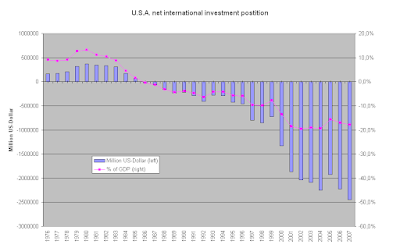

If the same debt had been accumulated by a single person, or a single company, they would have had to pay it or go bankrupt. When it comes to countries, things are more complex. However, I think that it can be safe to assume that such great deficits are not healthy to any economy.

But it gets even worse, I'm afraid. At first, manufacturing was out-sourced to economies with cheaper, but less proficient, work-force. However, two parallel processes have been developing over time based on this move: 1) the work force in those 3rd world countries has become more and more proficient, and 2) as they become more proficient the West have shifted the manufacturing of more complex goods to these countries. Let's take Brazil for example. Cars have been manufactured in Brazil since the late 1950s, starting with Toyota and Volkswagen, and in the last 50 years this industry have evolved with almost all modern car manufacturers working there (see link above). Brazil manufactures about 3 million cars and has passed France as of 2008, with high end models like Volkswagen Beetle as an example. However, if one can manufacture cars in Brazil, why not progress to the aerospace industry? Embraer is Brazil's most important aerospace manufacturer, and one of the four major manufacturers of commerce airplanes in the world (in the same league with Boeing, Airbus). Its major growth started in the 1970s. Nowadays, many commuter airlines in the US use Embraer models, especially the smaller ones that carry about 50-100 passengers.

There is nothing wrong with having 3rd world countries developing. On the contrary: when they develop there is a growing market for products that they could not afford earlier. However, as the manufacturing of more and more products is shifted, the local workers in the West lose their ability to manufacture complex products. In the last decade things have deteriorated to the point that Asian companies also design many of the "American" products. The Harvard Business Review writes that American companies have lost their ability to manufacture and design many of the small and simple things they used to be able to manufacture in the past. They even lost their ability to manufacture cutting-edge technology stuff, like the Kindle or the Boeing 787's carbon-fiber components.

Trade balance is just one angle. There is another one: government deficit, which also has been rising constantly. American administrations have always had problems with balancing their sheet, but since Clinton's administration the situation has been going from bad to worse. The 2009 deficit is projected to be more than 1 trillion dollars, some say even 1.8 trillion dollars.

On the lower end of the scale one can look at the consumers. Until the burst of the credit bubble Americans just spent without any second thought, or so it appears. That's why more and more people have huge debts and they turn to defaults and bankruptcies. This in turn is just a symptom of the illness I tried to present earlier: if manufacturing is low, as a whole, then each worker should have less money to earn. Less money to earn - and increased consumerism - must boil down to debt, that's simple math.

So, what is the correct way? How do you fix it? If I had the answer to that, I would probably win the Noble prize. However, it seems to me that the government has to reign in the uncontrollable masses. How? First, levee much higher taxes. This will also improve the government deficit. For example, if each American paid additional $1000 a year in taxes, the deficit would decrease by 350 Billion dollars. $5000 more a year, and the deficit is gone! Tax rates in America are low, compared to the rest of the Western world, however, Americans are not likely to allow this tax raise, and the administration will not be able to do it until the crunch gets much worse. One may argue that higher taxes will result in lower growth rates, which is the last thing desired during an economic crisis. That is true, but high deficit also boils down to more expensive debt for anyone, and higher credit costs, which in turn hinders long-lasting and healthy growth. So, which problem is bigger? Higher rates or higher taxes? Interesting. If I were the president I would increase taxes significantly and try to eliminate the deficit or at least reduce it almost to zero, even at the cost of immediate, short-lived, growth. He has 4 years in office and can afford it. Short-lived "bubble" growth that stems from the stimulus plan will likely to evaporate faster than we think - perhaps before the next presidential elections.

Another thing to consider is investment in bringing back the industry and science to the US. This should be done cleverly, as not all fields will yield the same desired results. However, science, engineering and information technology should come back to the US. Perhaps a new race to the moon is in order? On the other hand, the US has nothing to gain from its failing auto industry until this industry sheds all the excess and starts to make small, fuel efficient and cheap cars. In any case many Americans buy smaller cars from Japanese manufacturers that produce in America, so why support GM or Chrysler?!

Economy: hard to grasp. Let's stick to the basics: spend less than what you earn.

Tuesday, July 28, 2009

Good Things, Bad Things: Food and Nutrition

This post is part of the Good Things, Bad Things series.

Before we arrived in the States we had already known that good coffee is hard to come by here. In Tel Aviv, where we used to live, I was able to count between 10 and 20 coffee shops along Eben Gabirol (Hebrew) street, in the block between King David and Arlozorov streets, which is roughly the block I was living in. Indeed, at some point the best known coffee brand in the US, Starbucks, tried to establish a place in this same block. It was closed shortly after the opening, because Israelis were not willing to pay for the overpriced, low-quality, coffee that Starbucks had to offer, with all the better competitors around it (Hebrew).
We managed to find good coffee at Jungle Jim's, a local store, that sells food imported from all over the world. There, we were also able to find some of D's best loved food from the United Kingdom, such as HP Sauce, Branston Pickle, and tea, and some Israeli food, though not the most important product.

I think that the coffee world is the micro-cosmos of the entire food and nutrition industry in the US. The market is roughly divided into American low-end, American high-end, and international parts.

The American low-end part is intended for the use of the lower class / poor people. There you can get big portions for small bucks, and usually the quality is poor, taste is "industrialized" and nutrition values are questionable at best. Good examples for brands that specialize in this market are McDonald's, with the controversies regarding its nutrition values. As part of a varied diet, a Big Mac, as any other product of the fast-food industry, is something that I like to eat every now and then. The problem begins when one's entire diet is based on these products, and this person doesn't eat other types of food, especially vegetables and fruits. We, as students, found that we have to eat too much fast-food because of the limited variety at the university, that favors fast-food chains over nutritious options. However, we have choice, and we started to use it more often than before and bring home-cooked food, which is more healthy. Other people are not as lucky as us, I'm afraid. Since fast-food is cheap by design, many poor people prefer (or are forced by lack of other option) to eat it. if they were trying to eat vegetables or fruits instead of fast-food, it would cost them much higher for the same amount. This may explain why Americans have high rates of obesity compared to other developed and not-so developed countries. Combined with the existing health care system here, ranked 37 in the world by WHO, this can explain the high overall mortality rate in the US. But, I digress.

The second type of food here is the high-end American products. This includes brands like Starbucks, who sell a cup of latte for about $3-$5, depending on its size and the branch location. In comparison, for $5 you can get a foot long sub at Subway. So, only the rich can afford this type of food, but I'm afraid that to my taste it's not that tasty. Here I think plays another part of the equation, which is branding and "fanciness". I think that most people buy Starbucks on their way to the office to show that they can afford it, that they are successful. I haven't polled too many Americans (basically because I don't know enough), but the ones I did ask say that they don't like the coffee, and many of them prefer the bland American coffee to Starbucks' latte. Yet, they buy it in Starbucks for the paper-cup with the green logo.

The last type of food here is the part that we personally prefer: the international food. For lack of customers (I assume), Israeli and Mediterranean food is not the thing here in Cincinnati, except maybe the Mirage. However, this area has a lot of great Indian places, among which we found Krishna to be both cheap and tasty.

There are, however, some exceptions that I would recommend having in Israel. I really love the combination of quick service with good quality (mostly) Mexican food of the Chipotle chain. I also like the atmosphere, pastries and soups at Panera Bread's branches. In the Italian front perhaps we would recommend the Maggiano's chain of posh Italian restaurants. On the other had, we have at least two better chains of Italian restaurants, namely: Joya and Pasta Mia.

In conclusion, food - like many other things in the US - is a matter of social standing more than anything else. In addition, it's highly franchised and commercialized. If you want good food, you either have to make your own, pay a lot, or get really lucky.

Sunday, July 19, 2009

Good Things, Bad Things: Academy

This post is part of the Good Things, Bad Things list.

When we had just considered coming to the USA we were thinking about a good academic institution, which will help launch our careers in a new direction. We ended up in Cincinnati, mainly due to the fact that this is the only place where we could secure a good financial position. The academic level of the University of Cincinnati, albeit being rated in most fields amongst the top 100 in the US or 200 in the world, is certainly not even close to the academic level in the leading institutions. When I compare UC to the Technion, the level of studies that I had in my bachelors degree is much higher than the level of studies in the department here.

<---- A section here was harmonized ---->

One can simply argue that our findings should be limited to the specific university we're attending at the moment and that in other places the level is much higher. I agree with the logic, but we spoke with a girl we know that studies at a very good university, one of the Ivy League universities, and she said that the level of her studies is not so high as well. On the other hand, one of the professors at my department simply said that I expect too much, because I compare the Technion to UC, whereas I should compare the Technion to MIT. That's a very flattering way of putting it, but according to world universities rankings, the Technion is much closer to UC than it is to MIT. In fact, in most rankings American universities take 8 of the best 10 universities world wide. I wonder if they really are that good, or maybe the rankings are given by mostly American scholars, who get caught in the same trap most Americans are caught in: not realizing that there is a world outside the US, and that this world is just as smart and successful as they can be.

Another problem is that rating a university is almost an impossible task. Firstly, a university has many colleges and programs, and averaging the college of business with the college of arts is as relevant as averaging the size of elephants with the color of grass. Furthermore, even if you focus on the ranking of a particular college, department or program, there are still differences in the way each university is divided, and in many cases there are programs, e.g. aerospace engineering, which can be a separate department or a part of a department. Lastly, rankings - by definition - attribute a number to something. When it comes to a vague, and mostly non-numeric field as academic excellence, it is almost impossible to rate. So, several numerical factors are weighted to yield a ranking. However, who says that these are the right factors? For example, I saw in one ranking that the number of students is a factor. What does the number of students tell about the level of studies? If anything, it should be a curve with an optimum, while most universities are ranked by their ability to attract as many students as possible. And who decides on the weights of each factor? This is a completely subjective thing.

So, if rankings are useless we are back to the feeling of the student that takes the program. Currently, our feeling is that we should have been taking better programs.

Related links to university rankings:
http://en.wikipedia.org/wiki/Academic_Ranking_of_World_Universities
http://www.arwu.org/rank2008/EN2008.htm
http://www.arwu.org/rank2008/Top500_EN(by%20rank).pdf
http://www.webometrics.info/top6000.asp

Thursday, July 2, 2009

Good Things, Bad Things: Society

This post is part of the "Good Things, Bad Things" list I am trying to compile to describe our life here in Cincinnati before the first anniversary of our relocation.

There is no way around it, American society is a very ill society, almost to the point of a-socialism. If I may add a word to the English dictionary I would call it asociety. From top to bottom, from social infrastructure to daily life - nothing works in this asociety. On the list of bad things in Cincinnati, and perhaps the entire nation, I would say that American society is by far the worse.
American society is plagued by the following social pandemics: xenophobia, prejudice, and puritanism. I will now go on to explain in short what each pandemic is and how it manifests itself.
Americans are xenophobic. I don't think it's the result of the atrocities of September 11, most probably it is rooted far more in the past. They hate, fear and are repelled by foreigners on any level from the federal to the personal.
On the Federal level, this xenophobia starts with their requirements for visas. For example, Israelis are able to enter Canada as tourists without a visa, whereas they are required to have a valid tourist visa to enter the US. One may say that this is because Israelis tend to overstay their visas and work illegally. While this is true for some Israelis, it certainly isn't true for all, but more importantly the same incentives for Israelis to overstay in the US apply also for the Canadian case, so why the difference in policy.
On the personal level this xenophobia manifests itself in the most bizarre ways that American will use in order to avoid having strangers and even acquaintances in their home. For example, if they throw a party, they will do it in their yard or garage, just as long as no one will be allowed in their home. We see that every weekend in the area and it's unbelievable. It is as if Americans are afraid of having people in their homes.
Unfortunately, this xenophobia is not limited to their domiciles. D now faces something that I realized when I started working at the University: people hardly speak to each other at work. When they do, it's mostly on work issues and not personal stuff. As unbelievable as it may seem, people can spend a whole day here without ever talking with any of their peers. In Israel, when you're working there is always people to talk to. When you enter the office there's always "what's up?" and "how are you?". When one gets coffee (another big problem here), someone always joins in and you talk while making coffee. You even drink it together most often. People go to lunch together, all in the name of socializing. People care about each other and become friends, and then they invite each other home. It is unheard of that people are not invited to eat lunch with others on their first day at a work place. Absolutely none of that happens here. People here are like impenetrable bubbles, or even repelling magnets; if two happen to be too close to each other they utter "excuse me" and scurry away from each other without making eye contact.
The strangest thing is that Americans do it with the utmost politeness. If you happen to walk across someone he or she always greets you hello or nod their heads. They smile. They say "excuse me", and "thank you", though they don't say "your welcome" here, just a kind of an impolite "uh-huh".

Xenophobia goes well with prejudice. It's not pure racism as used to be here in the past, but undoubtedly it's better to be a white male than a black woman. Not to mention an alien. In Cincinnati neighborhoods are color-coded: the good are populated by whites and the African-Americans reside in the bad ones. This goes on to affect the schools they will study in, thus affecting their chances of social mobility. In general I would say that a black may become rich and successful, but it will take a unique talent, whether in sports or academy. The vast majority, perhaps 99%, will not be able to escape the fate of their ancestors. Perhaps a new African-American president will help bridge these gaps, but I have serious doubts. I think that most whites are still afraid of the Blacks around them, either because they have a different skin color (thus evoking xenophobia) or because they are used to thinking about them in terms of poor and violent people.

Perhaps as a method of helping them feel better about their ways, the people here tend strongly to be puritans. It's not a simple "bible-belt" thing, as we don't live in the area, but it's close and stems from the same Christian devotion. For example, women here tend to wear clothes that are less revealing than in Israel, while the summer here is as hot as in Tel Aviv. In D's new work place they have a booklet of instructions regarding proper behavior and attire: no Crocks, no jeans, and naturally no cleavage. Understandably, they will avoid saying words like fuck and shit, but they will also use words like gosh and hack, instead of God and hell, all in the name of the God they will not utter His name. Confused? So are we.

What's even worse, it seems to me that Israeli society is striving hard to become more American than American. Which means that we take the things that work well for us as Israelis and befoul them by imitating probably the worst society to have ever existed since the Roman Empire.