Showing posts with label Life. Show all posts

Wednesday, September 23, 2009

Good Things, Bad Things: Measurements and Distances

This post is the last and belated part of the Good Things, Bad Things series.

The USA is the only industrialized country to be using a systems of units that differs from the international standardized, or metric, system. In fact, the World Factbook by the CIA, in Appendix G, states that:
At this time, only three countries - Burma, Liberia, and the US - have not adopted the International System of Units (SI, or metric system) as their official system of weights and measures. Although use of the metric system has been sanctioned by law in the US since 1866, it has been slow in displacing the American adaptation of the British Imperial System known as the US Customary System. The US is the only industrialized nation that does not mainly use the metric system in its commercial and standards activities, but there is increasing acceptance in science, medicine, government, and many sectors of industry
This issue about units of measurements causes many differences, both for the good and for the worse. The system now called American Customary Units was derived from the English and later Imperial Units, but even that is not entirely correct or accurate. For example, an American Wet Pint is much smaller than its British counterpart (and even the Amreican dry Pint for that matter, but who the hell drinks a dry beer?!), and the only explanation for that might be that no one wants to drink more than an American pint of domestic beer, especially when compared to a nice smooth pint of Guiness. Anyway, I digress.

One problem with American Customary Units is that they hold true only at a certain location on Earth, specifically at latitude 45, which is roughly where the USA is. This is so typical of Americans: to invent a set of units that can be true only at a certain location in the universe. As usual, as long as Americans keep to themselves and don't try to meddle with the affairs of others that is not a problem. However, they rarely do, and at some point they even decided to venture to space. Now, on space, as everyone knows, there is no gravity. As a result, there is also no definition of weight, which is the force that stems from the product of mass and gravity, hence no gravity - no weight. Since the American Customary Units assume a weight of 1 lb as its basic unit of measurement, and calculates the mass that produces this weight at latitude 45 and sea-level, this entire system of units is useless in space. Thus, for scientific purposes, it makes more sense to use Standard International units, i.e. the metric system, whose base unit is the Kg for mass, and not weight. Mass is invariant no matter what the gravity acceleration is. Why am I telling you all this? For two reasons: 1) it's virtually impossible to teach American students to distinguish between mass, weight and the units used for both. They know that some multiplication or division is required, but not exactly which is what. 2) it's the cause of one of the most colossal failures in NASA's history.

There are also positive sides to using American units. For example, we still think about temperature in Celsius, but if you look at Fahrenheit it makes more sense: the weather in Cincinnati this year ranged from really cold when it was zero Fahrenheit to hot when it was 100 Fahrenheit. On the other hand, spatial distances are shrunk or expanded as needed: for example it's much nicer to live in a 1000 sq. ft. apartment than in a 100 sq. meters apartment. It's easier to drive 500 miles to a party than it is to drive 800 Kms, as we did on the weekend of the 4th of July. ;-)

Friday, August 28, 2009

Best hummus in Cincinnati

Is the one we make at home with our new food processor!!!!!

Good Things, Bad Things: Privacy

This post is part of the "Good Things, Bad Things" series.

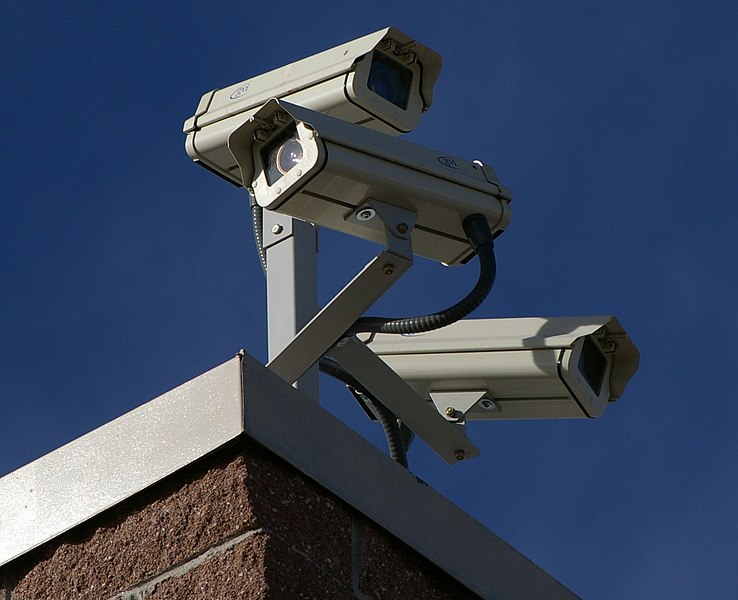
In general, the right for privacy in our world is diminishing. Some proof for that are: the ever growing number of CCTV cameras in city centers (especially in the UK, where this thing has almost gotten to the point of being a public Big Brother), Google's Street View and its privacy infractions, online mail applications that use key words to put contextual ads, and electronic data everyone leaves behind him just to prove he or she is still alive, e.g. on Facebook, Twitter, cellular networks, blogs, etc. To this one can add the debate over biometric database, especially the one lobbied for and promoted by MK Sheetrit in Israel.

Photo: Hustvedt for Wikipedia. Photo location: http://en.wikipedia.org/wiki/File:Three_Surveillance_cameras.jpg#file.

However, things really are nauseating when they come closer to oneself. One aspect of our lost privacy is the fact that the U.S. government requires every international student and international worker to report about his or her moves. We are already in the biometric database of the federal government as it is. And, lately, we discovered the that the University of Cincinnati, specifically one person in it is an avid reader of this very blog. This caused D and me to consider how much of what we experience in life should be made public through Facebook and blogging.

I have to say that although I hate having my rights being restricted by little people in dark suits, I support what the government is doing in attempt to prevent atrocities such as 9-11 from happening again. However, Sheetrit, this does not say that I support the biometric database promoted in Israel, there are other ways to have smart ID cards, and there are many nations that don't have ID cards at all, and biometric databases will not prevent terrorism or crime as you claim.

What I do hate, and I think there is no excuse for it, is having my freedom of speech trampled by little men that don't wear suits or badges. This is absolutely wrong.

Thursday, August 13, 2009

Good Things, Bad Things: Infrastructures

This post is part of the "Good Things, Bad Things" series.

In order to discuss the infrastructure in the US, let me first define what I mean by the term. For me infrastructures is everything that pertains to your ability to conduct your life. Good infrastructures are the ones that you don't have to think about: they are there, they are reliable, and they deliver everything you need when you need it.

In general I can say that the infrastructures in the USA are better than the ones in Israel. However, there are several exceptions to that rule. The infrastructures that are better than Israel are: broadband internet connection (we have 30Mbit/s fiber optics, at a cost that is lower than the cost in Israel for a tenth of that), roads (there are far less traffic jams here than in Israel), and the postal service, which is absolutely excellent, fast, efficient, and cheap. Service providers, and infrastructures providers among them, are usually more polite and don't require endless conversations to get rid of, but they are still inefficient just as their Israeli counterparts are. I really enjoy the banks here. We have an account with a major bank, and we pay absolutely no fees and get excellent service online and in the branch. It's a real pleasure that is in complete contrast to the appalling way Israeli banks work.

The infrastructures that are not as good as the ones in Israel are: buildings, that are built from IKEA style wooden plates and are just as strong as them, electricity, which has the tendency of failing every time there is a storm, public transportation, which is virtually non-existent in Cincinnati, and plumbing, which is a major problem in the building we live in, probably because of poor maintenance by the company that manages the property. The latter two are probably local problems, as public transportation in NYC, Boston, Chicago and San Francisco is supposed to be better, and the property management company is just one company and others may be better.

Though infrastructures in the US are better than in Israel, I feel that they may be deteriorating due to the economic problems. For example, the roads in Cincinnati have a lot of holes in them, and in the winter the city didn't plow the snow from the smaller streets or had money for salt to prevent the roads from freezing. Hopefully this is a temporary thing, that will pass when the economy improves.

Sunday, August 9, 2009

Good Things, Bad Things: Weather

This post is part of the "Good Things, Bad Things" series.

Weather in Israel can be described as having four seasons: December, January, February, and Summer. The former three are generally called winter, but are quite warm, but the latter ranges between hot and dry to blistering and humid.
After moving here I have finally realized that there are real differences between summer, fall, spring and winter. In the summer it's hot, muggy and rainy. In the fall the trees turn to all shades and colors. In the winter it's cold and sometimes snows. I really enjoyed the snow. Then, spring brings everything back to life, and the trees grow leaves in all different colors once more.

However, this wide range of temperatures and weather phenomena have a price: the weather here is very unstable. One day it's hot, the next it's soaking wet. Electricity lines were knocked out for several days twice since we came here. There are tornado alarms and flood alerts every now and then.

Still, I like the weather in Cincinnati, especially when it's not too hot or rainy.

Saturday, August 8, 2009

Good Things, Bad Things: Health

This post is part of the "Good Things, Bad Things" series.

Before we got here I thought that the Israeli healthcare system is not a good healthcare system. My mother had just died a month before we moved here, and I was angry with the way her treatment had been administered. It seemed to me that the healthcare system in Israel was too slow on one hand, yet too expensive on the other hand. This may still be true, but I have no doubt in my mind that when it comes to healthcare, the Israeli way is far better than the American way.

I use a report by the World Health Organization (WHO) to compare healthcare systems in the world. According to this report, though the Health Adjusted Life Expectancy (HALE) is high in the US (about 70+ years), it is not significantly higher than other countries, or perhaps even less than some. On the other hand the Total Health Expenditure in the US is one of the highest in the world, with Sweden and Germany (See figure 1.6 in that report). In fact the expenditure for healthcare in the US is so high, at about 15% of the GDP, that it is described as "singular" by the WHO (see page 106), compared even with other "high-income" (or developed) countries, which spend less than 10% of their GDP on healthcare. It is also singular in the fact that only 6.9% of the GDP is invested by the government, whereas the rest of the expenditures (almost 9% of GDP) comes from the private market. Although 6.9% of GDP government intervention is by no means low, the fact that so much more money is invested by the private sector contributes to high inequalities in the American healthcare system. This was not overlooked by the WHO: when it comes to universal coverage, the WHO has a lot to say about the inequalities in the American healthcare system, citing a decline of up to 5 years in the life expectancy of women in more than a thousand counties in the nation, where hazardous material are being disposed of (page 56), and the lack of care for uninsured elderly people (page 57).

In overall, it is thus not surprising that the United States of America is ranked number 37 in the world according to a WHO report that assesses the healthcare systems of countries in the world. What may be more surprising is that among the countries that have a better healthcare system than the USA we can find not-so-developed countries, such as Oman, Colombia, the United Arab Emirates, Dominican Republic, Costa Rica, Morocco, or even Israel (ranked 28). On the other hand, the United Kingdom is ranked number 18, with an expenditure which is only about 6% of its GDP, compare to the 15% in the USA. The highest ranking country is France. Obviously money isn't everything, contrary to common American belief. So, what is important in achieving a capable healthcare system?

The first thing that I can think of is mentioned in the WHO report: universal care. In American lingo this translates to Socialism, however, this is not what the WHO says. One should understand that to be healthy, it is not enough just to pay your ever-growing health insurance policy. It is also important that your neighbor, who may not be as lucky in securing a good healthcare plan as you are, is healthy. For some odd reasons, bacteria and viruses tend to ignore the sum of money you have in the bank, or the type of insurance card you have from your healthcare provider. If your neighbor becomes sick, chances are that you will fall ill as well. Especially if this neighbor is unable to pay for a visit to the doctor, or for the pills prescribed to him. And with 16.6% of Americans uninsured (as of 2007, I believe this percentage will be much higher, as unemployment has risen from about 4% or 5% at that time to about 9.5% today), that means that one of every 6 households are not insured. So, if you live at a house and you have neighbors on all your sides, at least one house around you is uninsured, won't go to the doctor, and there is a high chance you will contract his flu. A proof of that can be seen by the number of H1N1 (swine flu) victims in the USA, which is the highest in the world, 436 confirmed deaths, and it's not even fall or winter here. Yet.

However, it is not enough to make insurance accessible to the lower classes of the population. President Obama suggested a reform that will add a government option for Americans in addition to the private plans. I can't see how this is much different than the existing Medicaid program, but that is only me - I am not a recondite of the American healthcare system. It seems to me that a government run plan as an option is too little too late. Naturally asking for more from the American people, who genuinely believes that it has the best healthcare system in the world, is too much so the president has to settle for this little. Yet, even this is too much for the Americans, and the republican party fights it in every way it can, including scare and slur tactics.

In addition to that, there is a growing anxiety here about president Obama's alleged plans to "socialize" the country. Stemming from the stimulus plans (the first one, which bailed out the banks was actually passed in the term of the Bush administration, but don't confuse the GOP with facts), there were growing concerns about the growing intervention of the administration in the economy and now with the healthcare reform - in the healthcare system. As I wrote in the previous paragraph, I think that the healthcare reform is not enough, but even if President Obama's plans were to socialize the healthcare system completely (as per the GOP's scare tactics), what evil could come from this "socialization"? The worst that can happen, with these kind of expenditures spent on health as they are now, is that the American system will be similar to, and probably exceed, the ones in Germany (ranked 25 in the world), Sweden (23), Norway (11) or France (1). What's wrong with that?

Monday, August 3, 2009

Good Things, Bad Things: Economy

This post is part of the "Good Things, Bad Things" series.

I am no economist. I do not know how to make good investments, never have known and probably will never know. I know one thing about economy: you have to spend less than what you earn. Otherwise, the expenses overcome the income and you go bankrupt. Simple as that. This is the number one rule of home economics. So, how did we get to the current mess?

We got there by simply not following the rules. I'm sorry, not rules - a rule. There isn't much really to it. But why didn't we follow one simple, 6-words rule? I think that the reason is quite simple: we, the people, wanted to have more, better, and fancier stuff. Somehow during the last 50 years the US-led Western economy has shifted from manufacturing based to consumer based. Instead of a positive influx of money into the US (and Germany, Japan, and other Western countries) we now spend much more than what we get. To get them, we shifted the plants that manufacture them to areas of the world that do not observe the same workers rights that we do in the west. It can be merely not paying the same salaries, but often it also involves longer working hours with little rest or no weekends, under-aged workers (not to say child slavery in the extreme cases), and so on. The average price of a T-Shirt has been dropping for ages at a rate of several percents, mainly because it is cheaper to manufacture them in places like China, Indonesia, or the Philippines, while Western textile factories have shut down. As another example think about the demise of the shoe-repair shops. Until 20-30 years ago when a shoe was torn, people went to repair them, now we buy a new pair of shoes. There is no incentive to keep shoe-repairing shops anymore and they shut down. This is one part of the equation - buy more products with the less money spent per each product. This not necessarily reduces the amount of money we spend on consumer products, and surely enough - we as a civilization have been spending more and more.

At the same time, the same factories and manufacturing that were shifting to the undeveloped world caused the Western civilization to have ever bigger gaps in the balance of trade between the West and the 3rd world. For example, the American balance of trade with China and Japan has been in a great deficit over the last 25 years (since 1985), causing an ever growing debt to these countries, as can be seen in the figure below, which is the work of Alex1011 and is taken from Wikipedia.
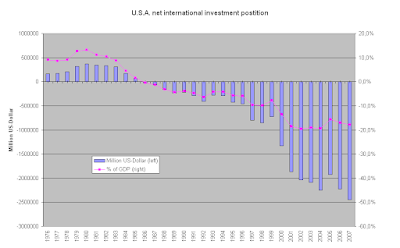

If the same debt had been accumulated by a single person, or a single company, they would have had to pay it or go bankrupt. When it comes to countries, things are more complex. However, I think that it can be safe to assume that such great deficits are not healthy to any economy.

But it gets even worse, I'm afraid. At first, manufacturing was out-sourced to economies with cheaper, but less proficient, work-force. However, two parallel processes have been developing over time based on this move: 1) the work force in those 3rd world countries has become more and more proficient, and 2) as they become more proficient the West have shifted the manufacturing of more complex goods to these countries. Let's take Brazil for example. Cars have been manufactured in Brazil since the late 1950s, starting with Toyota and Volkswagen, and in the last 50 years this industry have evolved with almost all modern car manufacturers working there (see link above). Brazil manufactures about 3 million cars and has passed France as of 2008, with high end models like Volkswagen Beetle as an example. However, if one can manufacture cars in Brazil, why not progress to the aerospace industry? Embraer is Brazil's most important aerospace manufacturer, and one of the four major manufacturers of commerce airplanes in the world (in the same league with Boeing, Airbus). Its major growth started in the 1970s. Nowadays, many commuter airlines in the US use Embraer models, especially the smaller ones that carry about 50-100 passengers.

There is nothing wrong with having 3rd world countries developing. On the contrary: when they develop there is a growing market for products that they could not afford earlier. However, as the manufacturing of more and more products is shifted, the local workers in the West lose their ability to manufacture complex products. In the last decade things have deteriorated to the point that Asian companies also design many of the "American" products. The Harvard Business Review writes that American companies have lost their ability to manufacture and design many of the small and simple things they used to be able to manufacture in the past. They even lost their ability to manufacture cutting-edge technology stuff, like the Kindle or the Boeing 787's carbon-fiber components.

Trade balance is just one angle. There is another one: government deficit, which also has been rising constantly. American administrations have always had problems with balancing their sheet, but since Clinton's administration the situation has been going from bad to worse. The 2009 deficit is projected to be more than 1 trillion dollars, some say even 1.8 trillion dollars.

On the lower end of the scale one can look at the consumers. Until the burst of the credit bubble Americans just spent without any second thought, or so it appears. That's why more and more people have huge debts and they turn to defaults and bankruptcies. This in turn is just a symptom of the illness I tried to present earlier: if manufacturing is low, as a whole, then each worker should have less money to earn. Less money to earn - and increased consumerism - must boil down to debt, that's simple math.

So, what is the correct way? How do you fix it? If I had the answer to that, I would probably win the Noble prize. However, it seems to me that the government has to reign in the uncontrollable masses. How? First, levee much higher taxes. This will also improve the government deficit. For example, if each American paid additional $1000 a year in taxes, the deficit would decrease by 350 Billion dollars. $5000 more a year, and the deficit is gone! Tax rates in America are low, compared to the rest of the Western world, however, Americans are not likely to allow this tax raise, and the administration will not be able to do it until the crunch gets much worse. One may argue that higher taxes will result in lower growth rates, which is the last thing desired during an economic crisis. That is true, but high deficit also boils down to more expensive debt for anyone, and higher credit costs, which in turn hinders long-lasting and healthy growth. So, which problem is bigger? Higher rates or higher taxes? Interesting. If I were the president I would increase taxes significantly and try to eliminate the deficit or at least reduce it almost to zero, even at the cost of immediate, short-lived, growth. He has 4 years in office and can afford it. Short-lived "bubble" growth that stems from the stimulus plan will likely to evaporate faster than we think - perhaps before the next presidential elections.

Another thing to consider is investment in bringing back the industry and science to the US. This should be done cleverly, as not all fields will yield the same desired results. However, science, engineering and information technology should come back to the US. Perhaps a new race to the moon is in order? On the other hand, the US has nothing to gain from its failing auto industry until this industry sheds all the excess and starts to make small, fuel efficient and cheap cars. In any case many Americans buy smaller cars from Japanese manufacturers that produce in America, so why support GM or Chrysler?!

Economy: hard to grasp. Let's stick to the basics: spend less than what you earn.

Tuesday, July 28, 2009

Good Things, Bad Things: Food and Nutrition

This post is part of the Good Things, Bad Things series.

Before we arrived in the States we had already known that good coffee is hard to come by here. In Tel Aviv, where we used to live, I was able to count between 10 and 20 coffee shops along Eben Gabirol (Hebrew) street, in the block between King David and Arlozorov streets, which is roughly the block I was living in. Indeed, at some point the best known coffee brand in the US, Starbucks, tried to establish a place in this same block. It was closed shortly after the opening, because Israelis were not willing to pay for the overpriced, low-quality, coffee that Starbucks had to offer, with all the better competitors around it (Hebrew).
We managed to find good coffee at Jungle Jim's, a local store, that sells food imported from all over the world. There, we were also able to find some of D's best loved food from the United Kingdom, such as HP Sauce, Branston Pickle, and tea, and some Israeli food, though not the most important product.

I think that the coffee world is the micro-cosmos of the entire food and nutrition industry in the US. The market is roughly divided into American low-end, American high-end, and international parts.

The American low-end part is intended for the use of the lower class / poor people. There you can get big portions for small bucks, and usually the quality is poor, taste is "industrialized" and nutrition values are questionable at best. Good examples for brands that specialize in this market are McDonald's, with the controversies regarding its nutrition values. As part of a varied diet, a Big Mac, as any other product of the fast-food industry, is something that I like to eat every now and then. The problem begins when one's entire diet is based on these products, and this person doesn't eat other types of food, especially vegetables and fruits. We, as students, found that we have to eat too much fast-food because of the limited variety at the university, that favors fast-food chains over nutritious options. However, we have choice, and we started to use it more often than before and bring home-cooked food, which is more healthy. Other people are not as lucky as us, I'm afraid. Since fast-food is cheap by design, many poor people prefer (or are forced by lack of other option) to eat it. if they were trying to eat vegetables or fruits instead of fast-food, it would cost them much higher for the same amount. This may explain why Americans have high rates of obesity compared to other developed and not-so developed countries. Combined with the existing health care system here, ranked 37 in the world by WHO, this can explain the high overall mortality rate in the US. But, I digress.

The second type of food here is the high-end American products. This includes brands like Starbucks, who sell a cup of latte for about $3-$5, depending on its size and the branch location. In comparison, for $5 you can get a foot long sub at Subway. So, only the rich can afford this type of food, but I'm afraid that to my taste it's not that tasty. Here I think plays another part of the equation, which is branding and "fanciness". I think that most people buy Starbucks on their way to the office to show that they can afford it, that they are successful. I haven't polled too many Americans (basically because I don't know enough), but the ones I did ask say that they don't like the coffee, and many of them prefer the bland American coffee to Starbucks' latte. Yet, they buy it in Starbucks for the paper-cup with the green logo.

The last type of food here is the part that we personally prefer: the international food. For lack of customers (I assume), Israeli and Mediterranean food is not the thing here in Cincinnati, except maybe the Mirage. However, this area has a lot of great Indian places, among which we found Krishna to be both cheap and tasty.

There are, however, some exceptions that I would recommend having in Israel. I really love the combination of quick service with good quality (mostly) Mexican food of the Chipotle chain. I also like the atmosphere, pastries and soups at Panera Bread's branches. In the Italian front perhaps we would recommend the Maggiano's chain of posh Italian restaurants. On the other had, we have at least two better chains of Italian restaurants, namely: Joya and Pasta Mia.

In conclusion, food - like many other things in the US - is a matter of social standing more than anything else. In addition, it's highly franchised and commercialized. If you want good food, you either have to make your own, pay a lot, or get really lucky.

Thursday, July 9, 2009

Good Things, Bad Things: Technology

This post is part of the "Good Things, Bad Things" list I am trying to compile to describe our life here in Cincinnati before the first anniversary of our relocation.

A good thing about life here is the abundance of gadgets and technology. But it is not uniformly distributed around the US, between companies, or among people. For example, we are connected to the internet using a fiber optic cable and we have a bandwidth of 30Mbps download. That's something that most Americans can't get because the infrastructure just doesn't get to their houses. Some of them also don't want to be connected to the internet all the time, and prefer the old fashioned dial up.
However, if you are a technology enthusiast, like we are, you can get almost anything you want, for a price that is. I have a new Kindle2, which can download books using the cellular network provided for "free" by Amazon ("free" means it's part of the book's cost and there is no extra charge for it).

When we first moved here we decided that since we didn't have a lot of money we should not get a TV and rely on internet connection and online entertainment options. As most of these websites don't work outside of the United States, Israelis rarely experience them. However, we have found out that we can follow almost every show that plays, a day or two after it was aired, at any of the websites of TV channels: ABC, NBC, TBS, CNN, and I guess several more - all have sites that allow you to watch TV. There is also Hulu, which aggregates several of these networks for our convenience. From Israel we can watch channel 10 (except for the football games, which was very annoying), but their relying on Windows Media technologies is very annoying compared to the superior Flash technology that all American channels use nowadays.
And then you have Netflix, which for a very small fee a month ($9) streams unlimited videos and TV shows which were distributed on DVDs, or sends the DVDs (one at a time) home.
So, basically, we don't need any TV now. In the future we may get a computer to act as a media player and stream all the videos that we want to a computer monitor (30 inch maybe?).

The main problem nowadays is cellular connection. When we first arrived here this was one of the first thing we did, thinking that we will have to communicate in some way or another with one another and with others. So we went to the only company that was generous enough to give us a plan without credit history: Verizon. It was a huge disappointment. It seems that the company messes up the user interface of it's phones, in the name of uniformity and "ease of use". I couldn't deal with my pay-as-you-go phone, which was really horrible, and switched to T-Mobile as soon as I could. There I could keep my old Sony-Ericsson, because they have a GSM network, but they don't have a 3rd generation network in Cincinnati area. How pathetic is that? And what good does it do anyone that they have Google phones if they don't have the 3rd generation infrastructure to support them? In general it seems that none of the American networks supports 3G very well outside the main cities along the coast. And that is my main complaint about American technology: you can get it, but it is limited to the rich areas and rich people living in them. Try to get internet connection or 3G in Kansas or North Dakota. You'll be happy to have limited cellular connection and dial up internet there...

Thursday, July 2, 2009

Good Things, Bad Things: Society

This post is part of the "Good Things, Bad Things" list I am trying to compile to describe our life here in Cincinnati before the first anniversary of our relocation.

There is no way around it, American society is a very ill society, almost to the point of a-socialism. If I may add a word to the English dictionary I would call it asociety. From top to bottom, from social infrastructure to daily life - nothing works in this asociety. On the list of bad things in Cincinnati, and perhaps the entire nation, I would say that American society is by far the worse.
American society is plagued by the following social pandemics: xenophobia, prejudice, and puritanism. I will now go on to explain in short what each pandemic is and how it manifests itself.
Americans are xenophobic. I don't think it's the result of the atrocities of September 11, most probably it is rooted far more in the past. They hate, fear and are repelled by foreigners on any level from the federal to the personal.
On the Federal level, this xenophobia starts with their requirements for visas. For example, Israelis are able to enter Canada as tourists without a visa, whereas they are required to have a valid tourist visa to enter the US. One may say that this is because Israelis tend to overstay their visas and work illegally. While this is true for some Israelis, it certainly isn't true for all, but more importantly the same incentives for Israelis to overstay in the US apply also for the Canadian case, so why the difference in policy.
On the personal level this xenophobia manifests itself in the most bizarre ways that American will use in order to avoid having strangers and even acquaintances in their home. For example, if they throw a party, they will do it in their yard or garage, just as long as no one will be allowed in their home. We see that every weekend in the area and it's unbelievable. It is as if Americans are afraid of having people in their homes.
Unfortunately, this xenophobia is not limited to their domiciles. D now faces something that I realized when I started working at the University: people hardly speak to each other at work. When they do, it's mostly on work issues and not personal stuff. As unbelievable as it may seem, people can spend a whole day here without ever talking with any of their peers. In Israel, when you're working there is always people to talk to. When you enter the office there's always "what's up?" and "how are you?". When one gets coffee (another big problem here), someone always joins in and you talk while making coffee. You even drink it together most often. People go to lunch together, all in the name of socializing. People care about each other and become friends, and then they invite each other home. It is unheard of that people are not invited to eat lunch with others on their first day at a work place. Absolutely none of that happens here. People here are like impenetrable bubbles, or even repelling magnets; if two happen to be too close to each other they utter "excuse me" and scurry away from each other without making eye contact.
The strangest thing is that Americans do it with the utmost politeness. If you happen to walk across someone he or she always greets you hello or nod their heads. They smile. They say "excuse me", and "thank you", though they don't say "your welcome" here, just a kind of an impolite "uh-huh".

Xenophobia goes well with prejudice. It's not pure racism as used to be here in the past, but undoubtedly it's better to be a white male than a black woman. Not to mention an alien. In Cincinnati neighborhoods are color-coded: the good are populated by whites and the African-Americans reside in the bad ones. This goes on to affect the schools they will study in, thus affecting their chances of social mobility. In general I would say that a black may become rich and successful, but it will take a unique talent, whether in sports or academy. The vast majority, perhaps 99%, will not be able to escape the fate of their ancestors. Perhaps a new African-American president will help bridge these gaps, but I have serious doubts. I think that most whites are still afraid of the Blacks around them, either because they have a different skin color (thus evoking xenophobia) or because they are used to thinking about them in terms of poor and violent people.

Perhaps as a method of helping them feel better about their ways, the people here tend strongly to be puritans. It's not a simple "bible-belt" thing, as we don't live in the area, but it's close and stems from the same Christian devotion. For example, women here tend to wear clothes that are less revealing than in Israel, while the summer here is as hot as in Tel Aviv. In D's new work place they have a booklet of instructions regarding proper behavior and attire: no Crocks, no jeans, and naturally no cleavage. Understandably, they will avoid saying words like fuck and shit, but they will also use words like gosh and hack, instead of God and hell, all in the name of the God they will not utter His name. Confused? So are we.

What's even worse, it seems to me that Israeli society is striving hard to become more American than American. Which means that we take the things that work well for us as Israelis and befoul them by imitating probably the worst society to have ever existed since the Roman Empire.

Saturday, June 6, 2009

Sitting on the balcony

We have a small balcony. It was mainly unused so far, except maybe for piling up snow in the winter. As spring is almost over and summer is upon us, the neighbors all started putting garden chairs out. Today we also bought a couple of foldable chairs and now we are sitting outside, with our laptops, naturally. Thanks God for wireless LAN.

Sunday, May 3, 2009

Update: Work Load

It appears that I am the only one that started teaching right on the first term. According to the associate department head responsible for teaching, usually they give new faculty a quarter to get settled, and only then, on the second term, they start teaching, and even then only one course at that quarter. I started right away with two and continued with that rate. I’m also the only one with 7 courses a year. Usually the faculty teach up to 6 courses a year, and they have one quarter off after three consecutive quarters of teaching. It sucks to be at the bottom of the totem pole.
So, now I try to use the time off that I have every now and then to prepare my classes for the summer. It's not easy: I work full time with the two classes I teach now, I try to get some research done (even wrote a paper), and most of the time I am just exhausted from starting to each at 8AM every other day.

We have better prospects for D's quarter, on the other hand. She has finished two courses already, and now her time will be divided between only three classes and her work. It's still not easy, but at least she will have Mondays off now, and will be able to free some time over the weekends. Or so I hope.

We even find some time to follow several TV shows: Lost, Heroes, Lie To Me, Hisardut, and D sometimes catches episodes of Grey's Anatomy.

Wednesday, April 15, 2009

Some updates

Spring quarter has begun and we're about 25% in it. Spring itself, however, seems to be a crazy season here. The weather has been oscillating from warm shiny days to damp, rainy and even snowy days. The period of the oscillation can be measured quite accurately to 3-4 days. When the weather is warm everything looks very nice and indeed spring is beautiful here. D has posted some photos in her Flickr album.
Last weekend we also had our first ever guest here in Cincinnati! We had a friend of mine from New York over for the weekend. She had to rid herself from Passover sticky Seders (there are two here in the US, because diaspora Jews apparently celebrate each holiday twice) and fled to our sanctuary. She spent three days with us, which allowed her to experience the entire cycle of weather. On gloomy Friday (originally, Good Friday) we went to the Cincinnati Art Museum, which surprisingly was more impressive than what I had expected. The museum showed an exhibition compiled by the Israel Museum in Jerusalem on Surrealism and Dada works. This type of art is usually not my cup of tea, and indeed I could (and did) summarize some of the works as: hey, I can paint better than these blotches of paint on canvas. I did like the classic Alpha Romeo they put on exhibit in the museum: now this is art!
It cleared on Saturday and we went for a great walk in Ault Park, which is a lovely park minutes of walk from our house. Most of the photos in D's album were taken there (although a week earlier).

When it comes to observing the Passover tradition I'm glad to say that we didn't observe any of it. We didn't go to any Seder. We didn't eat any unleavened bread, on the contrary: we ate pizza. I think the only relation to the holiday's tradition was drinking wine on Seder. By the way, pizza and wine are our traditional way of celebrating this holiday, as we have done that in four of the last five years. Naturally, we also worked, studied and taught during the Passover week. So basically, we didn't feel any holidays spirit.

Today we made our first significant step into mutual recognition between us and the matrix, aka the State of Ohio: both of us took our driving test and passed. So now both of us hold a valid driver's license issued by the Bureau of Motor Vehicles of the grid. As stated in a previous post, we were required to pass all the driving tests administered, as if we haven't been driving for the past 17 years or so. At least now we hold a license that will - hopefully - enable us to be free of the passports we were carrying all the time: it is, after all, a valid ID. The driving test here is very short: about 15 minutes in total. The test has two parts: maneuverability test and actual driving. In the former one needs to drive from an original position through a rectangular area defined by 4 cones and then proceed either to the left or to the right of a fifth cone (called point), bringing the car to a stop with its rear at the line of the point, and parallel to the general direction of the area. Then, from this position one must reverse the car to its starting position (description of the test can be seen in this animation). The rules are that the motion forward and in reverse should be done without stopping and that the cones must not be driven over. Then, if one passes that part of the test, the second part of the test is a very short drive outside the testing center's parking lot. This proved to be very short and very easy. The funny thing, of course, that if we had failed the test, we would have simply get into our car, driving with our international license. Anyway, this is past us now, and thus, we have finally completed the work plan defined about a year ago for our relocation.

Sunday, March 29, 2009

Back to the Grind 2!

So spring break is over. It was far too short and I feel that I am definitely not as rested as should be before the beginning of a new quarter. The previous quarter was very busy indeed, and in the last weeks of the quarter I was working too hard - around 12 hours a day, 7 days a week. The students seemed to like my work, especially the students in my new class. I did try to give them a full academic curriculum as well as a nice time in class, using clips and figures. It seemed to be working and I am glad that they felt good with that. One of them has even left a comment that he hopes the department will keep me in the next years. After the comments in the fall quarter I am glad to have this kind of a feedback.

Meanwhile, it seems that we need to pass a driving test in order to obtain a drivers license from the matrix-controlled state we're living in. As newcomers to the US we are required to prove that our driver's license is real. This is of course absolutely preposterous: in order to take the driving test we will drive our own car to the exam center, and should we fail we will simply get back into the car and drive it back home. That's because our driver's license from Israel is apparently good enough for driving as tourists, but is not good enough for driving as Ohioans. As part of this ridiculous process we took a written driving test (aka "theoretic" test) and passed it (naturally). I was expecting to get the license right away and got very upset when I was told that I need to schedule a driving test. D received the news with much more acceptance than me, which is funny because it's usually the other way around.

Back to the quarter ahead of us: again, I teach two classes, only this time both of them are classes I have already taught, so there is much less work preparing for them (checking assignments and exams is still a hard work). I also take 6 credits of "research", which means that I am free to do whatever I want, as long as the adviser agrees with me. D is going to be very busy with a full curriculum and her part time work. The worst part is that I teach (as always) on Mondays, Wednesdays, and Fridays starting at 8 in the morning, while she starts her day in the afternoon. Tuesdays and Thursdays are the opposite: she goes to work early in the morning, while I am not teaching, and intend to spend the time at home. Thus, we will rarely see each other at the university, and I will not have a partner for lunch.

Sunday, March 8, 2009

Weekly summary: signs of spring

The last week was very busy. On Tuesday I had a presentation at the Dayton-Cincinnati section of the AIAA (that's the aerospace counterpart of the more famous IEEE). It felt like attending the Israeli aerospace conference: you drive an hour north, the conference has many small rooms with little attendance, and everyone tries to be polite. It was a new experience for me, being my first conference ever, and I'm not sure if I liked it.

On Wednesday I had my birthday. As always, this is a good time for reflections on the previous year. I received a lot of emails and posts on my wall in Facebook with birthday wishes, and thanks for everyone. D and I didn't have time to celebrate, as both of us are extremely busy at the moment with end of the quarter tasks. D wished me a happy birthday, bought me two books, and we promised that when the quarter will finally be over we will have more time to celebrate.

A positive development is the vast improvement in the temperatures. The last few days have been warm, above 20 degrees (Celsius of course), and yesterday's weather was very nice. I wish I had not been so busy with work and laundry yesterday so that I could have enjoyed it, like some of my neighbors did. On my way to the laundry room and back I saw a few of them hanging outside in the parking lot, playing music and getting some rare rays of sunshine. Today is a different story. It is still warm, but we have already had two sirens warning us from the risk of a severe thunderstorm, which could develop into a tornado. And since the buildings here are basically built as boxes of cardboard and wood, a tornado can simply lift everything up and crash it down. We can hear the wooden beams attached to the roof stretch when the wind blows. The trees have not started blooming again.

Others signs of spring follow also: the infamous spring break (that's when all the young American students fly to resorts in Mexico, get drunk, naked, and wild) is just around the corner. Today started the daylight saving time ("summer clock" as it is referred to in Israel) in the US. So now, not only that we are 800 Km west of where the Eastern clock is (meaning that the sun rises and sets late relative to the East coast), now it will happen even an hour earlier. So, again, we will wake up before the sun.

Thursday, March 5, 2009

Yearly summary: 35

It was my birthday yesterday. I am 35 years old now, and it's a good time, as any birthday, to think about the previous year and analyze it in terms of successes and failures. As always, my categories are: family, love, friends, work, academics, and life in general.
Before progressing to the analysis itself, two things overshadowed any other thing this year: the death of my mother and the relocation to Cincinnati. These two play a major part in any of the categories that follow, but more importantly they have an enormous impact on my daily life in general.
Family: undoubtedly, the death of my mother this year was the most significant event that changed my family life. The obvious thing, of course, is her being missing. She was the most significant member in my family to me, and I don't mean that I loved her more than the others, but simply that she was the closest one to me. My relations with my father and sister have always known ups and downs, each for its own reasons, that this is not the right time or place to divulge. However, my mother was always a person to whom I could talk and tell much of my life. Naturally, it was the case when I was younger and still lived with my parents, but even after I moved out permanently we still had a good relationship. Seeing her losing the shape of a human being - physically and mentally - was very hard for me. At some point, towards the last days of her life, when she could not control her body anymore due to the tumors in her brain, I was even hoping that the suffering would end for her. It's not easy, and it's not something to be proud of, but that's how I felt at the time.
After her death something has changed in the relations I have with my father and sister. This is also accompanied by the fact that I am away, but I think that now we are a bit closer (in the emotional sense) than we have ever been. I don't know how long this will last, and whether it will withstand the distance of me being here, or when I get back. Only time can resolve this question, but as of now I think that my family relationships have improved, and some of it is due to this tragedy.
In all, I'd say that the family aspect of the last year was very bad, but hopefully some good will come out of this.

Love: I consider the past year to be the best year for my relationship with D. It started with her moving to my place, continued with her being by me in the worst days after my mother died, and then we moved here. The only reason I could survive all these changes is her. I found in her strengths that I hadn't seen before. Less important, but worth to mention, is that my sister finally came to appreciate what D is, and came to respect her for being my true "significant" other. Not in the way the term is used by P.C. minded people, but by the essence of that term: she is part of my life that I cannot live without. Any other words that I can write will only diminish this message.

Friends: it takes bad times to realize who your best friends are and how much they are important to you. Last year had enough of those times and I can say that one of the hardest things now is the lack of my friends. I didn't even realize how many friends I have and how close I feel to them until we relocated. At first I wondered how long will I continue to write my weekly updates, but I felt that I had to do it, because I wanted my friends to be part of my life even though I'm far away. It became an important part of my life, and though it is a "half-duplex" - I only transmit and rarely receive answers, the importance is there. I think that I will try to make it more interactive in the future, with more personalized mails, especially if time permits. However, no technological means can be a substitute for face-to-face, same-room, interaction. Nothing. It's better than it was before, now that we have Skype, and messengers, and emails. Yet, it's not the same. It takes more efforts to maintain relationships like that, and, very understandably, it is far more important to the one away (me) than it is to the ones left behind. The other side of the equation is that I (or we) haven't made any friends here. Will I feel differently if we do make some friends here? I think not.

Work/academics: these two have become one now, and therefore should be discussed together. It was important to me to continue my studies, after a long and logical analysis of how my career is about to come to a dead-end. I think that this has not changed, but I doubt if we have made the right choices. Some of our doubts were expressed in previous posts. I think that this is a new experience for us, and it certainly the first time that I have an opportunity to see how academic life look from the inside. I have not developed any inclination towards academic life or professional life yet, and I am not sure that the University of Cincinnati should be the model upon which I make such decisions. I miss being around people that constantly challenge me. I had that at Ness. I think I can have that at other universities, but I don't feel that here. From the economic point of view, our situation has deteriorated relative to the one we had before moving here. It was expected, and I think that we are doing much better than I thought we would, and certainly our situation is better than most of the rest of the world right now. So, the right decision has been made and implemented, although the situation has not improved. However, right decisions should be judged by the view of a longer time period than a few months. Next year we will be a good time to make such decisions, and follow them through.

Life in general: last year was a year of great changes and not for the best. I think that I am less satisfied with my life now than I was a year ago. However, I have some optimism, because some things improved, and these improvements have the potential of staying for life. Unfortunately, some things have deteriorated, and they will also stay for good.

Sunday, February 1, 2009

Weekly summary: the important things

A short update this time.

In recent weeks I wrote about some not so important things, for example the new president and the new era he represents. It's good to know that we're past that and now the real important things can be discussed. Let's talk about the groundhog day for example. The winter so far was colder than usual. If you remember, the temperatures plunged to -19 Celsius at one time, and were below freezing for most of January. Last week we had a couple of days of ice storm, which left about a foot of snow on the ground and another centimeter of ice layer in between two layers of snow. The university was closed for part of Tuesday and closed on Wednesday. The worse, however, is that the storm knocked off power grids in the Midwest (that's us) and there are about million people without power now. Again. Lucky for us, our power still works. When there is no power in warm September, it may be annoying, but at least you're not freezing to death. The icicles outside thawed only today, when the temperatures soared to 9 Celsius and it was sunny. Not for long, though, because there are some forecasts for another storm next week, which will probably not hit our area. I can't believe that I say that, as usually I love the winter, but I would be happy to see some spring soon. Also, we have become very busy in the last few days, and the next time we will have time for fun will be in the spring break, and that's too far... We started to think about spring break, and maybe we will use it for some days in Chicago. We'll see how things develop. Anyway, spring break is too short to come for a visit.

The Superbowl is on now. Instead of watching it in a pub, like any other newcomer to the USA would do, I am watching it at home on my laptop (the other one, not the one I'm writing on right now). D is studying for one of her 4 tests this week or work on one of her 3 assignments. I had to do a few "work" things myself, and still need to study and do the new assignment in the class I am taking. No rest for the wicked.

By the way, what's the deal with not showing us who was eliminated on last Survivor? The production don't want us to know it's Arik, after a failed attempt of coup against Bashevkin?It's so typical of the production not to want Bashevkin to be eliminated as he is a guy that generates "rating". Yes. We're updated, we see it when we're too tired to study or work.

Wednesday, January 28, 2009

More snow and ice

I think we have a foot of snow. I haven't measured that, but it snowed for a few hours and now everything is white and beautiful. The twigs are covered by ice that fell all night long.
Which brings about more photos to upload:


Tuesday, January 27, 2009

Snow!

After wishing for a foot of snow, it started snowing yesterday evening. It hasn't got to an entire foot, but we do have about half a foot already, with more snow to come in the evening and tomorrow morning.
Meanwhile, enjoy the photos:


And how can one post photos of snow without dogs playing in it?


Monday, January 19, 2009

Weekly update: God bless America, and the rest of the world too

This is the end of a long weekend, the "Martin Luther King" day was celebrated today in honor of this great leader that was assassinated for having a dream. Combine this with the upcoming inauguration of the first African-American president and you have a reason for celebrating human rights and equality in the USA. Is it so indeed? I still feel that there is a large gap between the poor and the rich, where the poor are usually members of the minorities and the rich are members of the white majority, and perhaps this gap is even increasing. In one of Cincinnati's more upscale shopping malls, the Kenwood Towne Centre Mall, we saw that almost all the shoppers were white, while the people cleaning the food-court area were black. This gap, in my view, with its widening and almost unbridgable distance, is one of the biggest challenges that the American society needs to overcome. You could claim that Israel is following the same example, with increasing gaps between poor and rich. To this I can say that: you're right, it does, as mentioned before. However, it is still not as bad as it is here. And, finally, except the bad example we have with Ethiopian-born Israelis, the difference is not based on racial discrimination or the tone of the skin. Again, this might change in Israel as well.

One of the customs of a long weekend is shopping. We have decided to follow the tradition and went shopping today. Part of it was the tradition, but more importantly it was Circuit City going out of business sale. The prices were not as low as one would expect from this kind of a sale, but still, I managed to buy a good Sony Vaio laptop for less than $700 (after taxes). D couldn't find the media player she wanted to buy, but we decided to get one online. There's nothing like tradition.

The previous week was full of work and studies, but not only that. D started working for a company that her professors have found. The people in this company are certain that D and her friend will continue working for them during the internship part of their studies, which starts in the summer. There is no guarantee of that, though, and D continues to look for internship options. I handed my first assignment in the degree. As I mentioned in one of the previous updates, the professor teaching this course is K. I don't get to go to the lectures themselves because I teach at the same time. However, it is easy for me to ask the professor questions regarding the homework, and occasionally help him correct problems with the solutions manual that accompany the textbook. Therefore, it seems to be beneficial to both sides of the bargain (or as some call it "the win-win spirit").

I also had time to play a bit with Windows 7 beta on my old (very old) laptop. You can read about my initial enthusiasm, and later admission that my archaic laptop is not cut for this. As a new user of Windows Vista (installed on the laptop I purchased today) I don't think it is horrible, but it does become a pain when it requires you to authorize every single thing you do. It seems that Microsoft has decided to eliminate some of the pain in 7, and perhaps improve the performance of the operating system. My conclusion is: if you have time to play with it on a spare computer, especially if it meets the requirements, you are welcome to give it a shot. It will probably be better than Vista. Perhaps it's Vista Service Pack 2. It is definitely similar to Vista in many aspects.

This week was as cold as your mother in law. The temperatures went down to -19 Celsius on Friday morning, when we left to the university. This is subzero even in Fahrenheit's scale, in which the zero measures the freezing of a water / salt mixture. This may mean that the roads will be frozen even with the use of salt to prevent it. I think it has been below zero Celsius for more than a week now, with the occasional improvement when it snows. There isn't much snow, though, only an inch or two when it really snows. That's disappointing for me. I want some accumulation on the ground to play with the snow, build a snowman perhaps, and make a snow angel. So far all we have is a thin white coating, which doesn't thaw since it's cold, but doesn't accumulate either.

One final note regarding Gaza: I'm glad that this cycle of violence is finally over, and I do hope that Hamas has learned its lesson. I don't feel we'll be that lucky though. Only time will tell who has emerged from this conflict with the upper hand, and what will be the Israeli response to every rocket, which will undoubtedly be launched. As I have been saying in recent years, Israel should react with full power to any attack on its citizens. I think that if we had done so 3 years ago we wouldn't have to cause so much damage now. I also think that the international community has yet again showed that it doesn't mind when Jews are being killed. Luckily, we live in a conservative state in the US, where the general public supports Israel actions, but we did have a Palestinian display at the students' center at UC. As I understand, the Jewish and Israeli organizations are working to set up a pro-Israeli display to counter that one.